Planning and review
Manual entry, portion changes, tracking and groceries. AI proposals are editable and require confirmation before logging.
A calorie and macro tracker with meal planning, progress tracking, portion adjustments and grocery list generation.
A personal nutrition tracker connecting meal planning, food quantities, progress and groceries. AI can interpret a food description or photo and propose food references and portions for review. Deterministic calculations produce the totals. Guest access and verified accounts use the same application.
Open project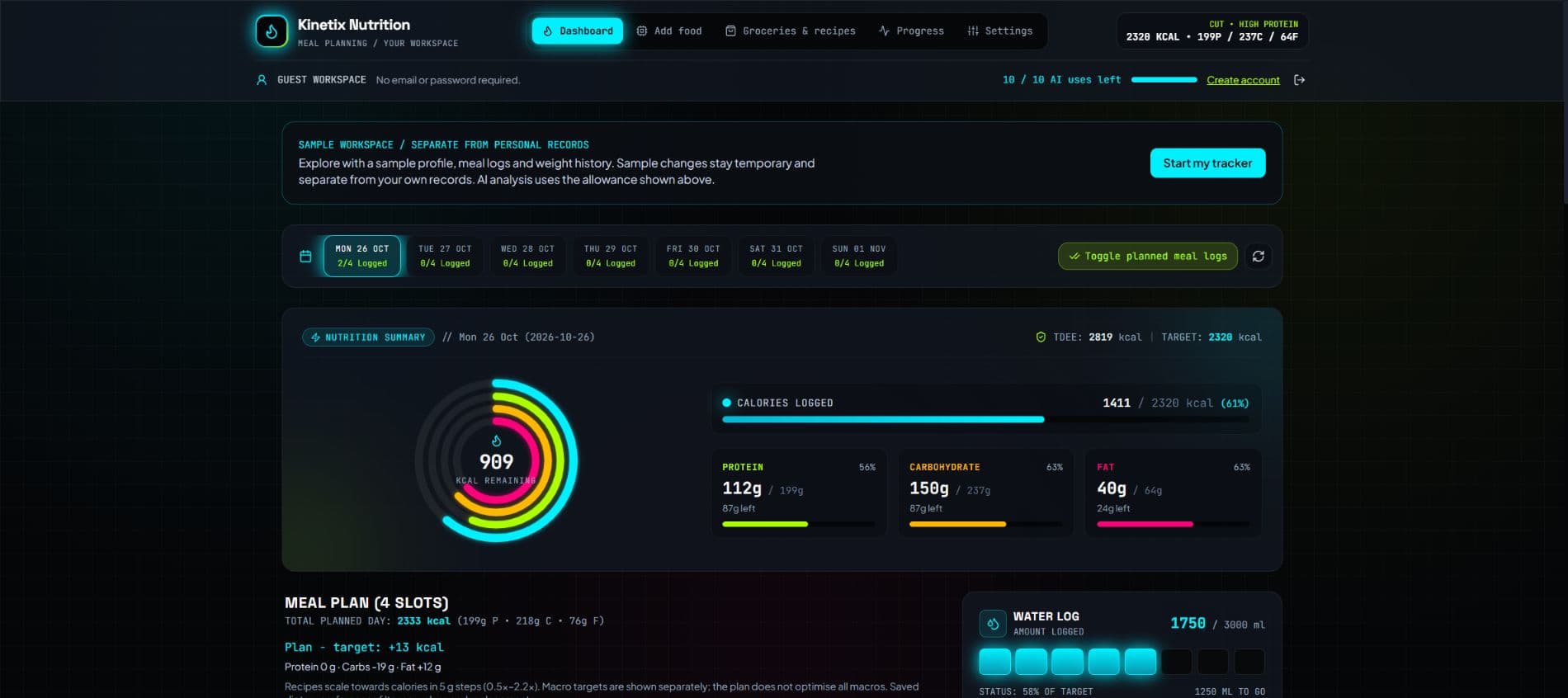
Captured from the live product, October 2026 · Sample planning workspace. Sample records stay separate from personal tracking; guests can also try reviewed AI food entry.
A nutrition plan is useful only if a person can adapt it to what they actually eat. Portion changes need to flow through meal totals and shopping quantities, while uncertain inputs and sample data remain clearly distinguishable from personal records.
Personal project, co-built with AI: built the planning interface, calculation rules and a sourced 103-food catalogue, then added owned cloud workspaces, dietary filters and reviewed AI text and photo entry.
A deliberately simplified view of the product. The decisions below explain the boundaries that matter.
Manual entry, portion changes, tracking and groceries. AI proposals are editable and require confirmation before logging.
Verifies the native session, validates food references and quantities, reserves AI allowance and checks workspace revisions before saving.
Kinetix tables keep each identity’s workspace separate. Browser caches preserve local edits; cloud conflicts pause saving for a deliberate resolution.
Proposes supported foods and estimated grams. Reference values and deterministic calculations produce totals; a photograph cannot measure a meal.
The applications share Supabase Auth, with separate app data and a session on each domain. Native guests own their work; email verification can retain that identity. Privileged credentials and AI allowance decisions stay on the server. The recorded scenarios below inspect specific application rules; the release checks describe what was verified in the live applications.
AI proposes supported food IDs and gram quantities; reference data and typed calculations produce the nutrition totals. A person reviews the proposal before logging. Unsupported items need a reference choice or explicit omission, rather than invented values.
Photo recognition cannot measure a portion or reveal every ingredient. The interface treats its output as an editable estimate. Manual food entry and planning remain available when AI is exhausted or unavailable. Guests get ten successful analyses; the server reserves their allowance atomically.
Four eating patterns and nine ingredient exclusions filter new plans, recipe choices, substitutions and food-entry review. Plant-based always uses vegan ingredients. Saving preferences rebuilds unlogged meals while preserving historical logs. Filters describe generic reference ingredients; they do not establish brand ingredients or cross-contact safety.
Native guest and verified identities own their cloud workspace in the shared Supabase project. Account-specific browser caches preserve local edits. Revision checks pause a conflicting save, and reloading cloud data archives the local copy first. Linking and verifying an email retains the same guest identity.
Choose a scenario to see what the project code actually returned with synthetic inputs. These are recorded local checks, available without an account.
An unknown dish produces a clarification request and no invented calories. A mixed known/unknown description cannot be committed as a partial log.
Why this matters. Uncertainty should stay visible instead of turning into an authoritative-looking number.
Actual TypeScript calculation and workspace modules transpiled with the checkout’s TypeScript compiler and executed locally. Synthetic clock (25 October 2026), synthetic storage and synthetic food descriptions; all results asserted before capture.
Local deterministic source checks. No real user/browser data, AI calls, hosted database, clinical validation, image recognition accuracy or full security/load audit. Nutrition calculations use generic USDA reference foods; this does not measure an actual meal.
Source revision bb05dc9ce147 · Verified 2026-10-26. The source checkout is required to rerun these checks.
Inspect the verification harness (requires the project source checkouts to rerun).
[
  {
    "title": "Unknown description rejected",
    "input": {
      "text": "unrecognized test dish",
      "slot": "lunch"
    },
    "result": {
      "items": [],
      "unresolved": [
        "unrecognized test dish: no supported food match. Choose a food from the catalogue or edit the description."
      ],
      "assumptions": []
    }
  },
  {
    "title": "Mixed input cannot create a log",
    "input": {
      "text": "100g chicken, mystery dish"
    },
    "result": []
  }
]